
Vetting people is my job, and "please check our nanny" reaches us more often than any other family request. It almost always sounds the same: we found someone through an agency, everything seems fine, but we would like to be sure. And it almost always turns out the family has not done even the free minimum — not out of laziness, but because nobody told them the minimum exists.
The articles online do not help. I read a dozen of the top-ranking pieces on vetting a nanny: they explain in detail which questions to ask at the interview and that you should ask to see the medical book. But not one of them contains a single link to a state register — at best a vague "check whether the bailiffs have any enforcement orders against her." This article has those links, and they are the part worth taking away.
Three levels of vetting: what you do yourself, what to buy, what nobody should sell you#
Before opening any register, it helps to set the frame. A nanny, a driver and a housekeeper form a trust perimeter — the circle of people with physical access to your home and knowledge of the family's routine. An insider inside that perimeter is more dangerous than any outside attacker for one reason: they do not need to break anything. The door has already been opened for them.
Hence three levels of work:
- Do it yourself, for free. Documents and their authenticity, open state registers, calling referees, the open digital footprint. This is roughly 80 % of the practical value.
- Worth paying for. A structured interview with cross-verification of the candidate's account, identification of referees, correlating the digital footprint across several identifiers.
- Nobody should sell you this. Reports pulled from leaked databases, lookups through closed sources, covert filming. Since December 2024 this is not a grey area but criminal law — more on that in the section on the legal perimeter.
There is a fourth item nobody can give you: a guarantee. Vetting lowers probability; it does not remove risk. Anyone promising otherwise is selling reassurance, not security.
Documents: don't take them on trust, verify them#
The document list is much the same everywhere — passport, medical book, criminal-record certificate, diploma. What almost nobody explains is how to confirm the documents are genuine. That is the actual work.
Passport and migration status#
The validity of a Russian passport is checked through the GUVM MVD services (сервисы.гувм.мвд.рф)
by series and number. The answer is advisory: a legally significant one requires a written request
to an MVD unit, answered within 30 days. For hiring a nanny, the advisory answer is enough.
If the candidate is a citizen of a visa-free country, they need a work patent, and there are two details you will rarely see mentioned. A patent is valid only in the region that issued it, and, where the region has introduced such a rule, only for the occupation stated on it. A patent for construction work does not cover working as a nanny. Patents are checked through the same GUVM MVD services, by the series and number of the form.
The penalty for employing a foreign national without a valid patent sits in Art. 18.15 of the Code of Administrative Offences. The figures usually quoted — hundreds of thousands of roubles — apply to organisations; for private individuals the fine is 2,000–5,000 ₽, rising to 5,000–7,000 ₽ in Moscow, St Petersburg and the Moscow and Leningrad regions. The sum is small, but the money is not the point: an irregular status means the person in your home is exposed to pressure from anyone who knows about it.
The criminal-record certificate: how to read it and what it leaves out#
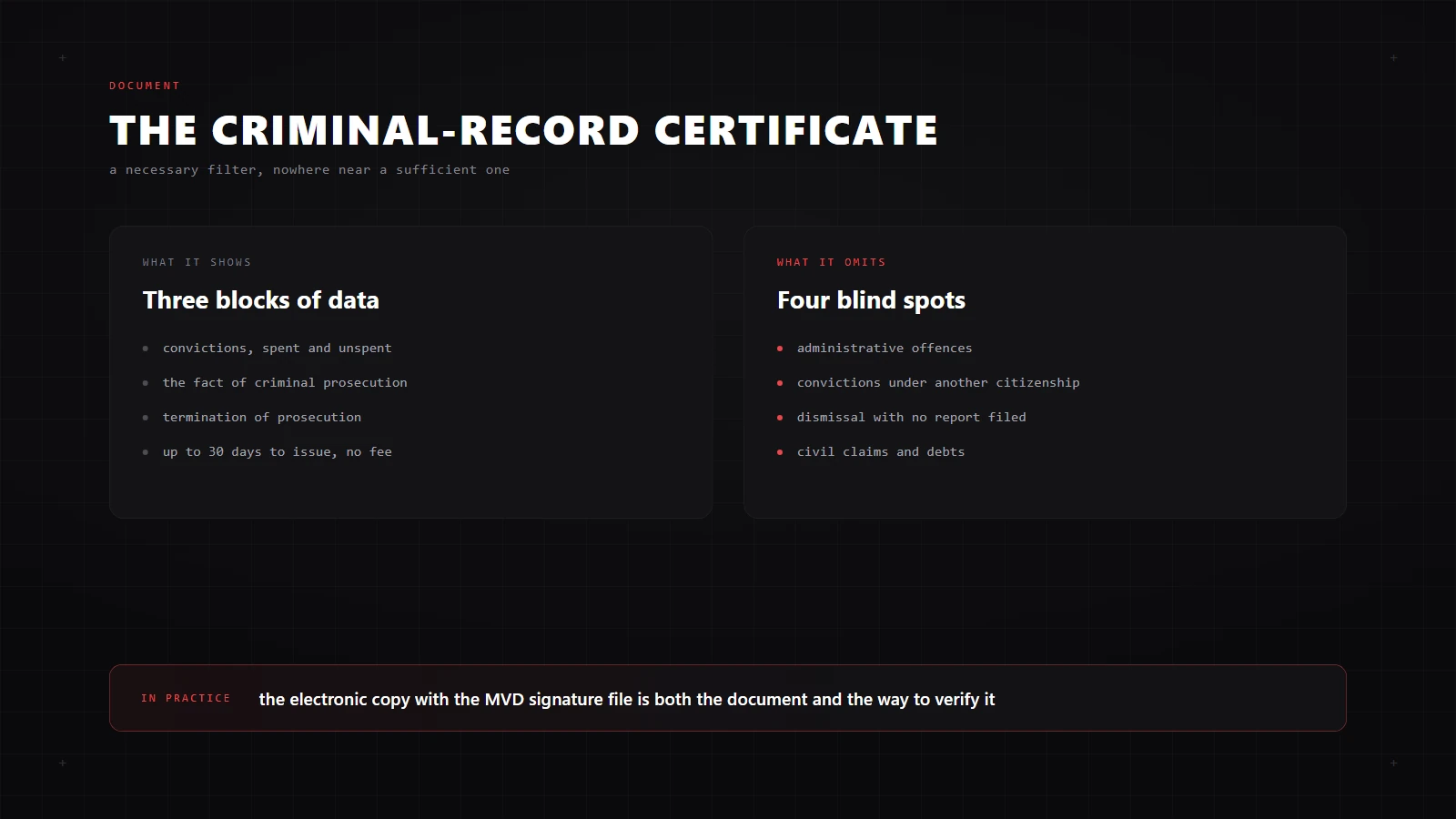
The document's full name is longer than people usually write: "certificate on the presence (absence) of a criminal record and (or) of the fact of criminal prosecution or of the termination of criminal prosecution." It carries three separate blocks of information, and "clean" in the first does not mean clean in the rest. The second and third — the fact of prosecution and its termination — are the ones read carelessly.
In practice:
- It takes up to 30 days to issue, in both paper and electronic form; there is no state fee. Asking for it "by tomorrow's interview" is pointless: either the candidate already has one, or you budget a month.
- The candidate orders it. An employer can only do so under a power of attorney plus consent to personal-data processing — in practice, don't. Ask them to order it through Gosuslugi and send the electronic version together with the MVD signature file: that gives you both the contents and the means of verifying them. A paper copy is far easier to forge than a ministry's signature.
Now the part this section exists for. What the certificate does not show:
- administrative offences, including those involving alcohol and drugs;
- convictions and prosecutions under another citizenship — for staff from CIS countries this is an outright gap, and nothing closes it;
- situations where no case was ever opened: someone was quietly dismissed for theft and no report was filed — the certificate will be blank;
- civil claims and debts.
Hence the logic of everything that follows: the certificate is a necessary but nowhere near sufficient filter, and the next steps cover precisely its blind spots.
A word on your right to ask for it. Art. 351.1 of the Labour Code restricts work in the education and upbringing of minors for people convicted under a range of articles, and in organisations — a school, a nursery, a sports club — the certificate is mandatory. Whether that rule extends to a family hiring a nanny directly, I could not establish: there is no Rostrud clarification on this exact situation. So the correct wording in negotiation is not "I am entitled to demand this" but "in our family this is a condition of employment." A refusal to produce it, from someone willing to discuss everything else, is information in itself.
The medical book: verified by QR in thirty seconds#
Here something changed that articles about nannies have barely registered. Personal medical books are now kept electronically, and Rospotrebnadzor maintains a register open to employers: whether the book exists in the database, and the dates of professional hygiene training and certification.
Three routes, fastest to most reliable:
- Scan the QR or barcode on the form — the codes are embedded in it and lead to the register.
- The "LMKontrol" app — identifies a book by QR or by manually entered details.
- The web register —
lmk.cgon.ruandelmk.rospotrebnadzor.ru.
The practical conclusion is simple: ask not for "the book" but for the book and a QR scan in front of you. A candidate who "left it at home but definitely has one," and a candidate whose book is not in the register, are two different conversations — and the second one ends there.
One caveat. A medical book covers the sanitary risk: infections. A narcologist's stamp in it is not the same as an absence of dependency.
The legal precision is this. Mandatory medical examinations under Ministry of Health Order No. 29n of 28 January 2021 apply to staff of children's organisations — nurseries, schools, camps. A nanny hired directly by a family does not fall under that list, so her medical book is established market practice and a reasonable condition of hire, not a statutory duty. In practice this changes nothing: a nanny without a valid book is either new to the work, or someone who was not hired where the book gets asked for.
Diploma and certificates#
Educational documents are checked in FIS FRDO, the federal register of documents on education. The
public search service sits on the Rosobrnadzor site (obrnadzor.gov.ru, "search for information on
educational documents," at the foot of the page), and it is free.
Two limits worth knowing in advance so you don't draw false conclusions. Records do not appear instantly — a recently issued document may not show up yet. And the older the diploma, the higher the chance it is not there at all: the register filled up gradually, and continuing-education providers were only obliged to submit data from 2019.
So "not found in FRDO" is not a verdict but a prompt for a follow-up question: where and when did you study, do you still have the original? A genuine graduate answers without hesitating.
Public state registers: twenty minutes, zero cost#
This is the core of the article and the thing missing from every page in the search results. All the registers below are public, free, and work from a browser.
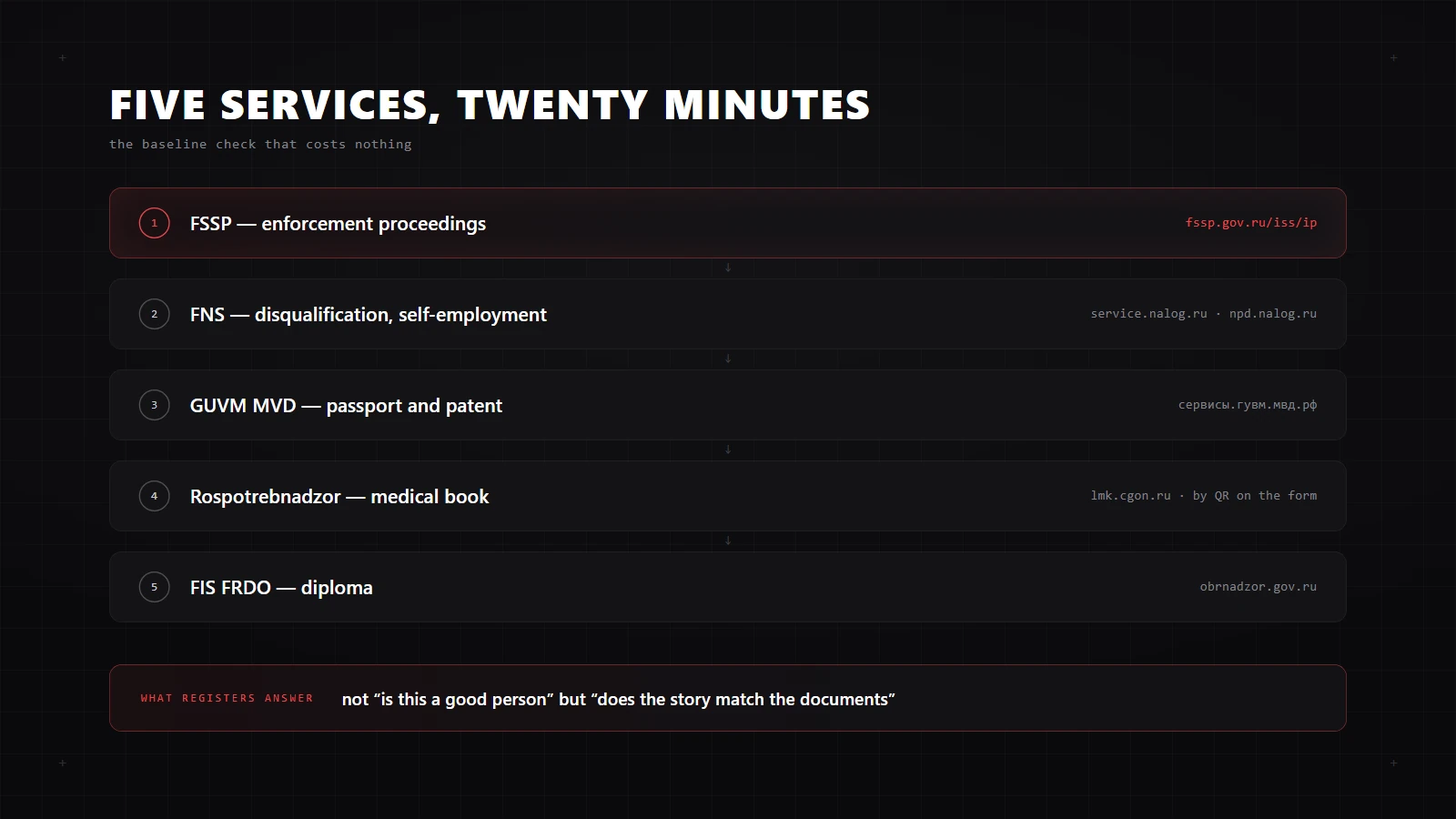
| Register | Address | What to enter | What it shows | What it does not show |
|---|---|---|---|---|
| FSSP enforcement proceedings database | fssp.gov.ru/iss/ip | full name, date of birth, region | open proceedings: amount, subject (loans, child support, fines) | debts with no proceedings opened; debts outside Russia; credit load as such |
| Register of disqualified persons (FNS) | service.nalog.ru/disqualified.do | full name, date of birth | bans on holding management positions; updated daily | domestic risks — it is a register about executives; relevant for an estate manager, rarely for a nanny |
| Self-employed status | npd.nalog.ru/check-status/ | tax number and date | whether the status is active on a given date | income, reliability, other employers |
| FIS FRDO | obrnadzor.gov.ru | document details | whether the diploma is confirmed in the register | quality of the education; very new and very old documents may be missing |
| Rospotrebnadzor medical-book register | lmk.cgon.ru | QR from the form, or details | validity of the book, certification dates | the quality of the medical examination itself |
| GUVM MVD services | сервисы.гувм.мвд.рф | passport, or patent form, series and number | validity of a Russian passport and of a patent | the answer is advisory, not legally significant |
| Bankruptcy register (EFRSB) | bankrot.fedresurs.ru, "Debtors" | full name and date of birth, tax number or passport | bankruptcy proceedings against an individual | debts that never reached bankruptcy |
| GAS Pravosudie, sudrf.ru, sudact.ru | search by name | full name | court rulings involving the person | much is stripped out by the anonymisation of personal data in published rulings |
The bankruptcy register works without registration or subscription — bankruptcy information is public by law, and anyone may look at it.
And the main idea to hold on to while working through registers. They do not answer "is this a good person"; they answer "does what I was told match what is documented." An enforcement order over a loan is no reason to refuse: half the country has loans. An enforcement order alongside a claim of "no financial problems" is a reason — because the problem is not the debt but the willingness to lie to an employer about money while living in their house.
References: telling a real employer from a friend#
"Call the previous employers" is advice everyone gives. The trouble is that a dishonest candidate brings along a briefed acquaintance who will say exactly what the reference letter says.
The working technique is to test memory, not the story. A fake referee will reproduce the letter, but will not survive the details that are not in it.
- Identify the referee rather than accept a contact. A number handed to you by the candidate proves nothing. Look at whose number it is: avatar and name in messengers, linked accounts, whether the person exists in open sources at all.
- Ask what is not in the CV. How old were the children when the nanny left, what were their names, which district did the family live in, how did she travel there, who else worked in the house.
- Build the chronology backwards: "when did it end" → "when did it start" → "what happened between that job and the next one." Gaps of three to six months are the most common point where a story falls apart.
- The red flag is not criticism but sterility. "Everything was wonderful, no complaints at all," with no single concrete situation, is the classic fake-referee answer. A real employer almost always recalls at least one rough patch: lateness, a disagreement about routine, something ordinary.
The candidate's digital footprint: what to look at and what it means#
The advice to "check their social media" also travels from article to article, and everywhere it takes exactly one line. The work, though, is not to "read a profile" but to connect identifiers: phone number → messenger accounts → username → other platforms → photographs. Each step gives you an independent confirmation or contradiction of the account you were given.
The order of work:
- From the number. Which messengers are linked to it, what name and avatar are on display, how the number is labelled in other people's address books — services like GetContact show exactly those third-party labels, and past employers and agencies that never made the CV tend to surface there. A caveat: GetContact itself harvests data from its users' address books, and that is worth understanding while using it. More on what a number exposes is in a separate piece on finding someone by phone number.
- From the username. Enumeration across platforms. The main difficulty is false positives on common handles, so every hit is confirmed by hand against the avatar, registration date and writing style. Tooling and method are in the article on finding someone by username.
- From photographs. Reverse image search on the profile picture surfaces accounts opened under another name; how that works is covered in the piece on finding someone by photo.
- Correlation with the account given. Do the cities and periods match the story about previous jobs?
The red flags here are not the ones amateurs look for. It is not about "bad photographs":
- a gap between the story and the footprint — "five years with one family" alongside regular posts from another city during the same period;
- traces of a debt spiral — public requests for loans, subscriptions to microfinance communities; combined with a hit in the FSSP database this stops being a guess and becomes a picture;
- demonstrative publicity about employers — photographs of other people's children and other people's interiors in an open profile. This is the single best predictor available, and the logic is direct: she will display your home the same way;
- other people's faces in "her own" photographs — borrowed material in the profile.
The other direction: what your staff knows and posts about you#
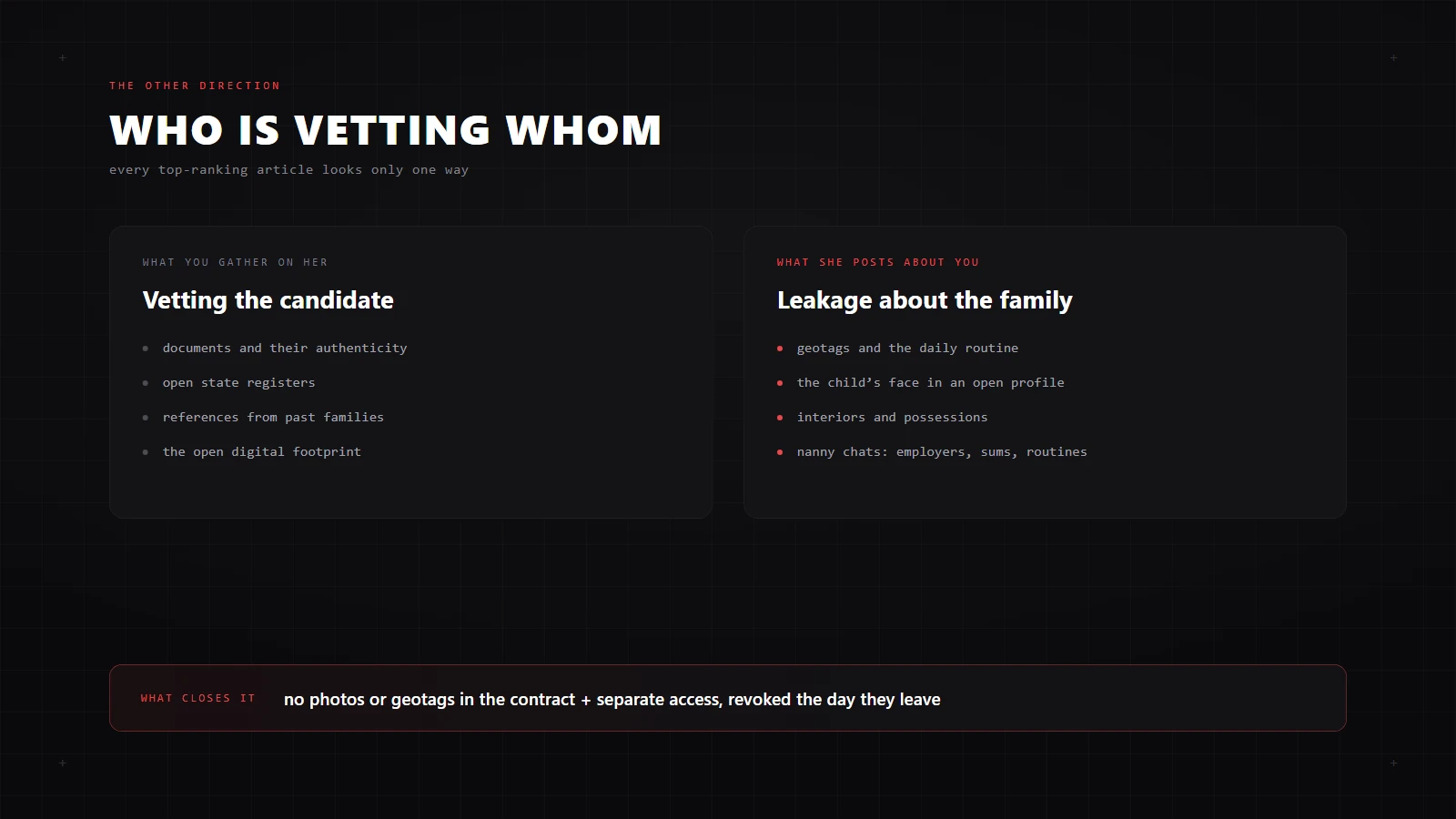
What follows is the most underrated part of the subject. Every article on vetting a nanny looks one way: check the candidate. But a nanny and a driver know things about your family that no outside attacker does — what time the child is collected from school and by which route, who is home during the day, when the family travels, what the interior looks like and what is in it.
This material leaks not through malice but through everyday publicity.
Leak channels#
- Geotags and real-time posts. "We're at the playground" plus a location tag equals an address and a time, every weekday.
- Photographs of the child in a nanny's open profile: the child's face becomes searchable by face-recognition tools.
- Photographs of the interior — a shop window for your possessions.
- Nanny and housekeeper group chats — by district, by residential complex, by agency. Employers, sums and routines get discussed there. It is an environment with no access control at all.
- A personal phone in the house — cloud backups and photo auto-upload into someone else's accounts.
- Smart home and cameras, to which staff were given access "to make things easier."
What the contract and device rules cover#
- A clause in the contract, or a separate confidentiality agreement: no publishing photographs of the children, the interior, or any information about the family; no geotags; liability for breach.
- A device rule: a personal phone, yes; filming the child on a personal phone, no; work photographs only into an agreed family chat.
- Separation of access: a separate smart-home account, a separate gate code, a separate guest Wi-Fi. All of it revoked on the day employment ends — that day, not "some time this week."
- A periodic audit of your own footprint — what is already visible about your family from outside. The reasoning and the tooling are in the pieces on OPSEC for executives and on deleting yourself from the internet.
The polygraph: what it actually shows#
Search for household-staff vetting and half the results are polygraph examiners and detective agencies. Their claim is uniform: the test will reveal cruelty to children, theft and dependencies, and a refusal to take it means the person has something to hide. That claim deserves a proper examination, because it is half wrong.
What the science says. The reference work here is the National Research Council report The Polygraph and Lie Detection (2003). Its findings:
- for specific incidents, the comparison test distinguishes lies from truth well above chance, but well below perfection; median accuracy is around 85 %;
- in screening — and hiring a nanny is screening — the method breaks against the base rate. In a group where genuine wrongdoers are rare, the test produces an avalanche of false positives. The report's own illustration: among 10,000 employees with 10 actual wrongdoers, tuning the test to catch about 80 % of them would see roughly 1,600 people fail it;
- accuracy degrades under countermeasures — and precisely in the motivated wrongdoer, the one person the test exists for.
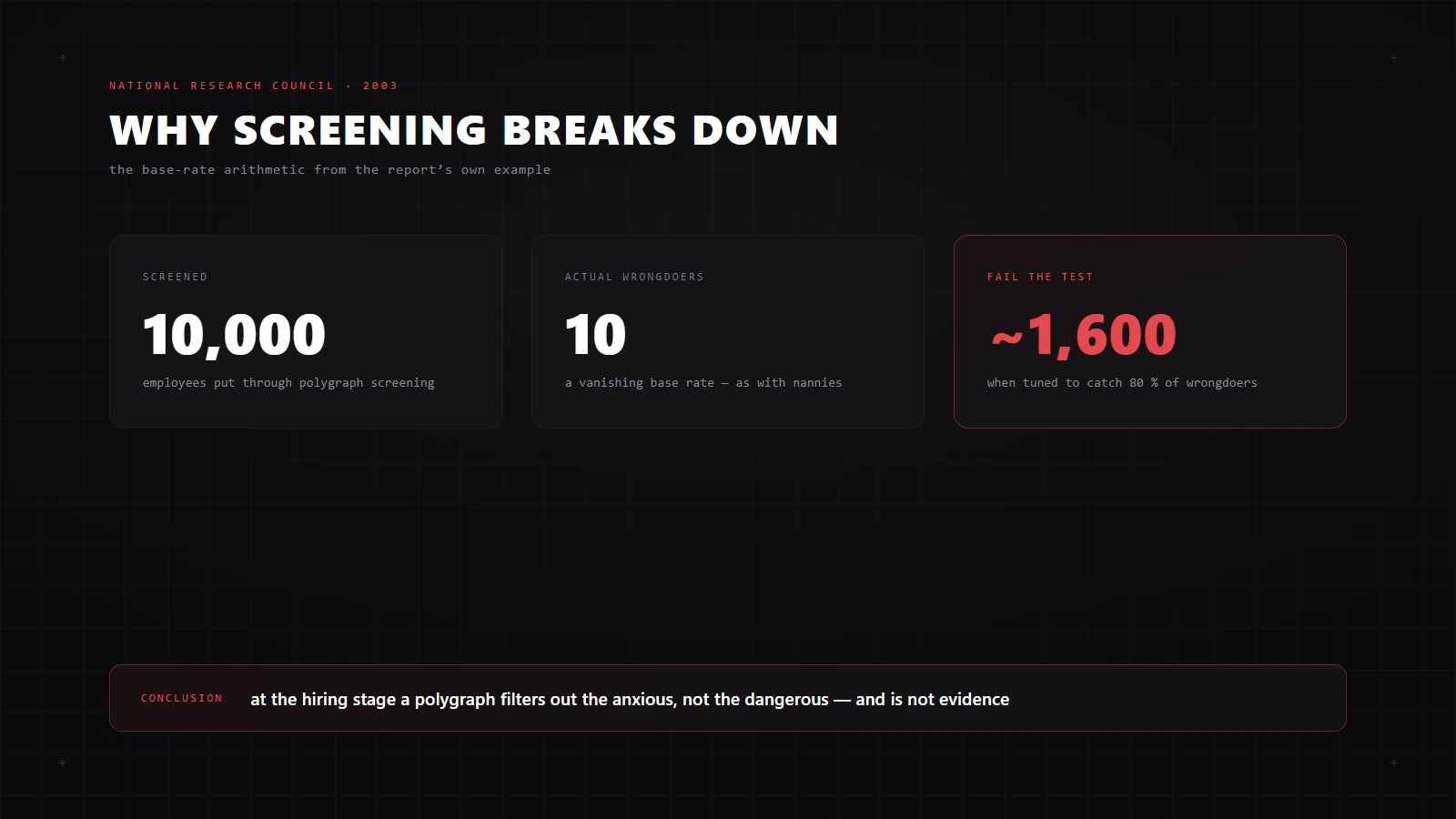
Apply that to your situation. You are testing one person rather than ten thousand, but the arithmetic is identical: the base rate of "nanny who is a criminal" is vanishingly small, so the overwhelming majority of "suspicious reactions" in screening are false alarms on honest candidates. At the hiring stage a polygraph filters out the anxious, not the dangerous.
What the law says. A polygraph examiner's conclusion is not evidence: psychophysiological examinations are not among the forms of evidence recognised by criminal procedure law, and this position is settled in Supreme Court practice. The practical meaning: if a nanny steals, the test result will help you neither in a criminal case nor in a civil claim. The testing itself is only possible with written voluntary consent.
The conclusion I give clients. A polygraph is not a hiring filter but a tool for examining a specific incident: a sum has gone missing, an item was damaged, the circle of people is defined. There the base rate is high and the method performs at its best. As for "he refused, so he's guilty," it is worth naming plainly: declining a procedure that is 85 % accurate and legally worthless is rational adult behaviour, not a confession.
Cameras at home: where protection ends and a criminal charge begins#
"Put in a camera" is advice given casually. In reality there are three separate legal questions here that usually get collapsed into one.
Covert filming engages Art. 23 of the Constitution, Art. 137 of the Criminal Code (inviolability of private life) and — separately and more dangerously — Art. 138.1 (illegal trafficking in special technical devices intended for covert information gathering). Practice on these offences is explained in Supreme Court Plenum Ruling No. 46 of 25 December 2018. Note the mechanism: exposure under Art. 138.1 arises at the point of acquiring a disguised device — a clock, a socket, a smoke detector — not only at the point of filming.
Open surveillance with notice is the workable option. The contract records where the cameras are, whether audio is recorded, how long footage is kept, and who has access. Cameras do not go in bathrooms, lavatories, or staff rooms.
Audio recording is a stricter regime than video. Recording conversations you are not party to is a risk of its own, and almost nobody draws that line.
Now to evidence, where two misconceptions circulate and both do damage. The first: "a court won't accept a recording made without consent." It will — the consent of the person filmed is not required for a video recording to be admissible. The second, its mirror image: "if consent isn't needed, I can film however I like." Also no, because the court assesses how the recording was obtained. Material gathered in breach of the law loses legal force and cannot form the basis of a judgment (Arts. 55 and 60 of the Civil Procedure Code).
And a practical requirement almost nobody knows about: when submitting a recording as evidence you must state when, by whom and in what conditions it was made (Art. 77 of the Civil Procedure Code). An open camera with a timestamp in frame and a clause in the contract satisfies that by itself. A hidden one does not, and drags along the question of how it came to be in the house.
Hence the conclusion that inverts the casual advice: a hidden camera protects you worse than an open one. The open camera both deters and remains usable — exactly when you need it.
And a layer nobody raises in the nanny context: a home camera is itself a leak vector. Default passwords, a stream exposed to the internet, a contractor's cloud access — a surveillance setup installed for a child's safety can, if configured badly, broadcast the family's daily routine outward. Whether your own credentials have surfaced can be checked against breach databases.
Roles: driver, housekeeper, security, carer#
The common package is the same for everyone, but each role carries its own risk profile.
A personal driver. Two risks a nanny does not carry: he operates a source of serious danger with your children inside it, and he knows every route and every schedule. In addition to the standard checks:
- checking the licence for disqualification — the official traffic police service at
гибдд.рф/check/driver, free and around the clock. What matters is that the service works from the licence's own details — series, number and date of issue. There is no search by surname alone, so you have to hold the licence and copy the details across. That is the difference between checking and going through the motions; - FSSP matters more for a driver than for a nanny: unpaid fines are both an indicator of discipline and a practical risk, such as a travel ban surfacing the day before a family trip;
- route discipline as a separate contract clause: no publishing locations, no discussing the family's schedule, rules for personal phone use in the car.
A housekeeper has maximum access to property and documents with minimal observation. The key here is not background but regime: a list of access zones, procedure for handling cash and purchases, separate storage for documents and valuables.
A carer has access to medication, bank cards, and a vulnerable person who may not complain. Professional qualifications are worth checking separately through FRDO.
Security is the one role where skipping the check is indefensible: this person knows your security arrangements from the inside.
Paperwork: the contract, Art. 303 of the Labour Code, and recovering damages#
Three models and their consequences.
An employment contract with a private-individual employer. Under Art. 303 of the Labour Code the employer must conclude the contract in writing, pay insurance contributions, and register the employment contract with the local self-government body at their place of residence. The last applies to employers who are not sole proprietors, and in practice is almost never done — simply because nobody knows the duty exists.
There is no separate fine for missing that registration where the employer has no sole-proprietor status: liability for breaches in formalising employment (Art. 5.27 of the Code of Administrative Offences) is framed for officials, entrepreneurs and organisations. But the penalty is not the main consequence — see below.
A contract with a self-employed person. Simpler to arrange, but carries the risk of the
relationship being reclassified as employment with back-assessments. Status is checked at
npd.nalog.ru/check-status/, and a receipt after each payment is mandatory.
Cash in hand. The core point: without paperwork you are not an aggrieved employer but a person with no legal relationship at all. Recovering damages, proving the work ever happened, calmly reporting a theft — all of it gets far harder, and the question of who exactly this person was in your house is now put to you.
The legal perimeter of vetting in 2026: why a database lookup endangers you#
This is the one section I consider required reading even if you skim the rest.
Since 11 December 2024, Art. 272.1 of the Criminal Code has been in force — unlawful use, transfer, collection and storage of computer information containing personal data obtained by unlawful means. Part one carries a fine of up to 300,000 ₽ or the convicted person's income for up to a year, or forced labour for up to four years, or imprisonment for the same term. Part two — the same acts in relation to the personal data of minors, special categories, or biometric data — carries up to 700,000 ₽ or income for up to two years.
Note the aggravating element. In vetting a nanny you are by definition working next to a minor's personal data — your own child's included. That is precisely the category carrying the higher liability.
The practical meaning for a family: buying a database lookup on a candidate is trafficking in unlawfully obtained data, and the customer is not a bystander in it. The advice to "order a check against the databases," handed out freely by articles from 2019–2023, is out of date in 2026 and has become dangerous.
An honest caveat: I found no body of practice on prosecuting customers rather than sellers of databases — the article of the code is young. This is a risk, not a conveyor belt of convictions. But the risk is asymmetric: the seller runs a professional risk and has priced it in; yours is a family one.
Private detectives are a separate story, and here one detail settles the question better than any discussion of legality. Having signed a contract to collect information about a person, a detective is obliged to notify that person in writing within one day. A lawful detective check on a candidate therefore cannot be secret in principle. An agency promising to "find out everything without them noticing" is not describing its discretion but a breach — and in that transaction the exposure is yours.
What makes vetting lawful: the candidate's written consent to the processing of their personal data and to the specific checks. That is a protective document for you, not a formality for them.
To put the whole subject in one sentence: vetting a candidate in 2026 is measured not by how much you can dig up but by how much you can learn without creating an offence of your own. The lawful perimeter is documents produced voluntarily, open state registers, the open digital footprint, and consent. Everything beyond it is bought from people whose trade is itself criminal — and those people arrive in your home along with the report.
Vetting isn't a one-off: when to re-check#
A check records a state on a date, and risk moves. Someone impeccable three years ago may since have taken on debt, developed a dependency, or come under pressure from third parties. Corporate security handles this through continuous evaluation — periodically revisiting clearance instead of vetting once at hire; both RAND and CISA have examined the approaches in their insider-risk guidance. Transferring that model to a household is our own interpretation, but the logic carries over exactly.
The domestic version is three repeatable actions and a list of triggers:
- every 6–12 months: re-check FSSP and bankruptcy. Two minutes, free. Enforcement proceedings appearing during employment mean far more than their absence at hire;
- annually: the medical book's currency in the register and, for a driver, licence validity;
- on a change of circumstances: divorce, a move, a sharply changed spending level, requests for loans, a new circle of acquaintances, the appearance of "a relative who'll stand in sometimes."
I press that last point separately. A stand-in is the most common way a completely unvetted person gets into a house.
If the check turns something up: parting ways#
Every article ends at "you've hired someone." But a person refused after a check knows more about your home than a random candidate, and that is a task of its own.
The principles we apply in practice:
- do not say what you found or where. It protects the source and avoids provoking a confrontation;
- decline without a detailed rationale. Accusations help nothing here;
- revoke every access on the day you part — codes, keys, smart-home accounts, guest Wi-Fi, family chats. Not "some time this week";
- close out payments and paperwork in full. Money owed to a former employee is the most common trigger for a conflict that then travels well beyond money.
What a paid check buys you#
An honest breakdown, because nobody selling these services provides one.
Free and within your reach: passport, patent, FSSP, disqualification, self-employed status, FRDO, the medical-book register, court rulings, calling referees, the open digital footprint. That is around 80 % of the value of vetting.
Cheap to buy: an automated aggregated report across open databases — it saves time, but contains nothing the registers above do not.
Requires a specialist: a structured interview with cross-verification of the candidate's account; identifying referees rather than taking their contacts on trust; correlating the digital footprint across several identifiers; examining a specific incident once one has occurred.
On money — by published price lists as of July 2026, and the spread itself is diagnostic. Polygraph screening of household staff in Moscow is offered both at 1,500–3,000 ₽ and at 10,000–15,000 ₽; an automated database report starts at 299 ₽. A fivefold difference in price for the same service means that at the lower end you are buying a half-hour formality, not a method.
If you need to vet not one person but the whole perimeter — nanny, driver, housekeeper, security — and to do it regularly, it makes sense to treat professional staff vetting as a process rather than a one-off service. But start with the free minimum in this article regardless: it closes most of the risk and costs you an evening.
FAQ#
How do I check whether a nanny has a criminal record?#
The candidate orders the certificate on the presence (absence) of a criminal record themselves through Gosuslugi: up to 30 days to issue, no state fee. Ask for the electronic version together with the MVD signature file, so you verify both the contents and their authenticity. Remember that the certificate does not reflect administrative offences or convictions under another citizenship.
What should be in a nanny's medical book, and how do I check it is genuine?#
Personal medical books are kept electronically: the book's existence and the dates of hygiene
certification are verifiable in the Rospotrebnadzor register — by the QR code on the form, through
the "LMKontrol" app, or on the register's site at lmk.cgon.ru. Ask for the QR to be scanned in
front of you.
Is it legal to install a camera to watch the nanny?#
Open surveillance with notice to the employee is legal if it is recorded in the contract — where the cameras are, whether audio is captured, retention period, who has access — and there are no cameras in bathrooms, lavatories or staff rooms. Covert filming engages Arts. 137 and 138.1 of the Criminal Code and undermines the recording as evidence.
Do I need a contract with a nanny?#
Yes. Under an employment contract, a private-individual employer is required by Art. 303 of the Labour Code to conclude it in writing, pay contributions, and register the contract with the local self-government body at their place of residence. Without paperwork, recovering damages and proving the work ever happened is close to impossible.
Is a polygraph worth using on a nanny?#
As a hiring filter, almost useless: screening a group with a low proportion of wrongdoers generates a mass of false positives, and an examiner's conclusion is not evidence in court. A polygraph is better suited to examining a specific incident with a defined circle of people.
How do I verify a nanny's references?#
Identify the referee rather than taking the contact on trust, and ask for details absent from the reference letter: the children's names and ages when she left, the district, the route, who else worked in the house. A fake referee will reproduce the letter but will not survive the details.